Persona
A persona is a single, named, made-up person who stands in for a real pattern in your research.
That's the whole idea. You talked to a dozen people, you found the things that held across them, and you fold those things into one specific character the whole team can picture. Not the average customer. Not a demographic slice. One person, with a name and a face, who behaves the way the pattern behaves.
It's one of the artifacts you build when you debrief and organize your research, alongside the journey map and the empathy map. I teach all three in the design thinking course at the Siebel Center for Design at the University of Illinois, as ways to turn a wall of synthesis into something a team can use.
This page is the make-one recipe. The case for why a persona matters, and the synthesis work that has to happen before you build one, lives back in Synthesis. That step isn't optional background, it's the prerequisite: a persona is built out of conclusions you already pulled from real interviews, so if you haven't done the synthesis, go do it first and come back. Invent a person from your own assumptions instead and you're not making a persona, you're making a mascot.
What it's for
A persona does one job. It gives the team one specific person to build for, so "the user" stops being an abstraction everyone fills in with themselves. Say "the user" in a room and every person hears a different one. The engineer pictures someone like the engineer. The loudest voice pictures themselves, and now you're building for the team instead of the customer. A persona pins it down. Ask "would this actually work for Marcus?" and everyone pictures the same Marcus. The argument gets honest.
The template
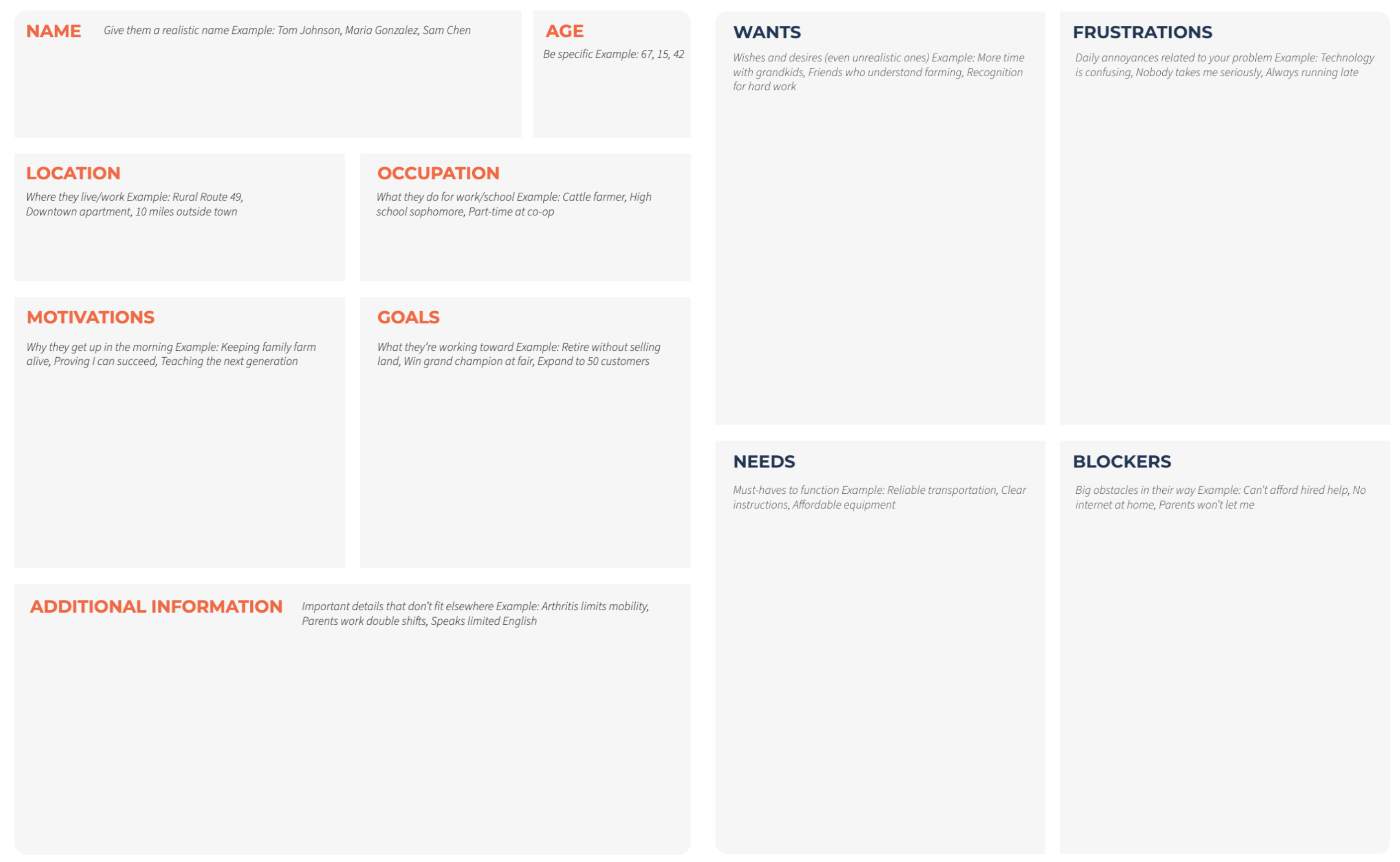
Keep a persona to a single page on purpose. The moment it sprawls, nobody reads it. The standard fields, drawn from the way Alan Cooper, the designer credited with inventing the persona, introduced it in The Inmates Are Running the Asylum, and the way the Nielsen Norman Group, the most-cited authority in UX research, teaches it today:
- Name and a face. A real first name and a stock photo or quick sketch. This feels silly the first time. Do it anyway. The name and face are what make the team talk about the persona like a person instead of a row in a spreadsheet.
- A one-line identity. Who they are in a breath. Role, situation, the context that matters for your product. Not their life story, just the part that touches the problem.
- Goals. What they're trying to get done. This comes straight off your user drivers, the list of motivators (what's pushing them to act) you named in synthesis.
- Pains. Where it hurts today. The friction, the workarounds, the thing they complained about. Straight off your user pains, the matching list of frustrations from that same synthesis step.
- Current behavior. What they already do about the problem right now, before you ever showed up. This is the one teams skip, and it's the one that saves you. The thing they already do is your real competition, even when it isn't a product.
- A quote. One line in their voice that captures their whole attitude toward the problem. Pull it from a real interview if you can. A good quote does more to make a persona stick than any other field on the page.
Two fields are optional and earn their place only when they change a decision: a short bio for context, and a line on what they believe, the assumption that drives how they act. Skip anything that wouldn't change what you build. Age, income, favorite coffee order. If it doesn't move a decision, it's set dressing.
Every field traces back to your research. If you can't point to the interviews underneath a line, cut the line. A persona you can't defend is just your own assumptions wearing a name tag.
A worked example
Here's one filled in. It's illustrative, built in the job-seeker world the design thinking course uses, not a real customer of mine. The point is the shape.
Dana, the over-applied job seeker
"I've sent out two hundred applications and heard back from four. I'm starting to think the problem is me."
- Identity: Mid-career, switching industries, three months into a job search and running low on confidence.
- Goals: Land a role that values her real experience, not just the exact keywords on the posting. Stop feeling like she's shouting into a void.
- Pains: Application fatigue from firing off resumes daily with no reply. "Entry-level" jobs that quietly require five years of experience. Automated rejections with no reason attached.
- Current behavior: Lives in the big job boards, applies to everything, tracks it in a messy spreadsheet. Has barely touched her own network because asking for help feels like admitting she's struggling.
- What she believes: That volume is the strategy. More applications, better odds. (Your research says she's wrong, and that gap is exactly the opportunity.)
Notice what's not in there. No age, no hometown, no hobbies. Every line is something you'd actually design around, and the "current behavior" line, applying by volume and avoiding her network, is the one that tells you where the real opportunity sits.
When to reach for it, and when not
Reach for a persona when the team keeps building for a vague "the user" and you need one face to aim at. It's the right tool when the problem isn't a single moment or a single sequence, it's a who, and when the disagreements in the room are really people picturing different customers. It also travels best: hand it to a new engineer, a designer, an executive, and they're aligned on who you're building for in thirty seconds.
Reach for the sibling artifacts instead when the shape of the insight is different:
- The problem is a sequence, where in the flow it breaks. Build a journey map. It walks the whole path start to finish and shows you the step where it falls apart.
- The gap is between what someone says and what they do, and that gap is the point. Build an empathy map. It holds the contradiction up where you can't look away from it.
And don't build one at all when you don't have the research to back it. A persona invented from your assumptions is worse than no persona, because it launders your bias into something that looks like evidence and gets quoted in meetings for the next year. No interviews, no persona. Go do the work first.
You don't need all three artifacts on every project. You need the one that puts your insight in front of the people who have to act on it in a shape they can't argue with. The persona is the one you reach for when the team has lost track of who they're building for, when you need one customer on the wall that everyone pictures the same way.